Calorie Calculator

Work out how many calories you really need in a day, and what to eat to lose weight at a pace you can hold.

Gender
years
kg
Height
cm
optional
%

Leave blank if you do not know it. Enter it and we switch to Katch–McArdle, which works from lean mass and is the most accurate of the three.

Advanced settings
Show results in
BMR equation

For information only — not medical advice, diagnosis or treatment. Figures use the Mifflin–St Jeor equation by default, the estimate most dietitians reach for. Two weeks of your own weigh-ins will tell you more than any formula.

Your results will appear here

Fill in the five fields on the left and press Calculate. You will get what your body burns in a day, and what to eat to lose weight at a pace you choose.

More detail on your numbers

Every target, side by sideLosing and gaining, at three rates each
Two 7-day zigzag schedulesSame weekly total, spread so the week has room in it
What moving up an activity level is worthWorked out from your own BMR, not a generic table

The short version of everything else

Open only what you need. Each card is a couple of minutes of reading, not a chapter.

How many calories do you actually need?Why two people the same weight can need 600 kcal apart

Your daily requirement is mostly set by how much tissue you carry and how much you move it. Age, sex, height, weight and activity explain most of the gap between two people — the rest comes from genetics, hormones, sleep, illness and how much you fidget, none of which a calculator can see.

For rough bearings: adult men usually sit somewhere between 2,000 and 3,000 kcal a day to hold their weight, and adult women between 1,600 and 2,400. A tall, active 25-year-old and a short, sedentary 70-year-old can be a thousand calories apart without either being unusual.

There is also a floor. Eat far too little and your body starts covering the essentials by taking apart the things you would rather keep, muscle included. Common clinical guidance puts the unsupervised minimum around 1,200 kcal a day for women and 1,500 for men.

Counting calories to lose weight, in five stepsThe whole method, without the motivational padding
  1. Get a baseline. Use the calculator above. If you know your body fat percentage, switch the equation to Katch–McArdle — it works from lean mass and tends to be the most accurate of the three.
  2. Pick a rate, not a number. A kilo of body fat is roughly 7,700 kcal, so a 550 kcal daily gap works out near half a kilo a week. Going past about a kilo a week is where the trade-offs start to bite; if you want to, do it with a doctor or dietitian watching.
  3. Choose how you will track. Paper, a spreadsheet, or an app. Apps win on friction — most can read a barcode or a photo and fill in the numbers for you — but the method that you will still be using in six weeks beats the method that is theoretically best.
  4. Re-check every few weeks. Your BMR falls as you get lighter, so a target that worked in week one will stall by week eight. Weigh yourself under the same conditions — same time of day, before breakfast — and judge on weekly averages, not single mornings.
  5. Keep going. Consistency does more here than precision.

Calorie counting is not an exact science, and it says nothing about the quality of what you eat. Calories in minus calories out is a real constraint, but foods differ in how full they leave you, how much energy digesting them costs, and what nutrients come along for the ride.

What calorie counting is quietly good atBeyond the weight on the scale

Most people underestimate what they eat, often by a wide margin. Logging for even a fortnight tends to rearrange your sense of proportion: a handful of crisps stops being free, and you discover which of your regular meals is doing the damage.

It also turns a vague intention into something you can act on. "Eat less" gives you nothing to check against; "1,850 today" does. And once you can see that a 220-calorie packet of sweets is about forty minutes of brisk walking, the trade becomes concrete rather than moral.

Portion habits shift on their own after a while. People fill the plate they are given and finish it, and restaurant portions have quietly taught most of us that three servings is one meal.

Zigzag calorie cycling, explainedWhy the same weekly total can be spread unevenly

Stay on a reduced intake long enough and your body adapts — the deficit shrinks even though the number on your plan has not moved. Zigzagging means holding the weekly total steady while varying the days: a couple of higher days, several lower ones.

Say your target is 14,000 kcal a week. You could eat 2,000 every day, or 2,300 on three days and 1,775 on the other four. Same total, less predictability — and a week that has room in it for a dinner out without the plan collapsing.

There is no settled research on the best pattern. A 200–300 kcal spread between high and low days is a sensible default; people with higher activity levels can go wider. The two schedules the calculator generates above are both built from your own numbers.

Which equation should you pick?Mifflin–St Jeor, Harris–Benedict and Katch–McArdle
  • Mifflin–St Jeor — the default here and the one most dietitians reach for. Published in 1990, and generally the most accurate of the weight-based equations for the general population.
  • Revised Harris–Benedict — the 1919 original, updated in 1984. Still widely used, usually reads a little higher than Mifflin.
  • Katch–McArdle — works from lean body mass instead of total weight, so it needs a body fat percentage. If you have a reliable one, this is the most accurate of the three, particularly for lean or heavily muscled people.

Whichever you pick, the output is an estimate with a real error bar around it. Two weeks of weighing yourself will tell you more about your true maintenance level than any formula.

What to do nextTurning a number into a week that works
  • Decide where the calories are being tracked before you need them — the first skipped log is usually the one you had no plan for.
  • Weigh in on a schedule and look at the weekly average. Day-to-day swings are mostly water and timing.
  • Recalculate every 4–6 kg of change, or every couple of months, whichever comes first.
  • Watch more than the scale. Losing weight while losing muscle is not the same result as losing weight while keeping it.

Reference tables

Collapsed by default so they stay out of your way. Open one when you need it.

Calories in everyday foodsReal serving sizes, with the protein each one carries
FoodServingkcalProtein
Meals people actually eat
Chicken and rice bowl1 bowl, 400 g56042 g
Cheese and tomato pizza2 slices of a 14″57024 g
Chicken burrito1 regular65034 g
Tuna sandwich on wholemeal1 round38526 g
Porridge with berries1 bowl, 300 g2409 g
Full English breakfast1 plate67031 g
Protein on its own
Chicken breast, grilled150 g24847 g
Salmon fillet, baked130 g26829 g
Eggs, two large100 g14413 g
Greek yoghurt, 0%170 g pot10017 g
Lentils, cooked1 cup, 198 g23018 g
Firm tofu150 g21626 g
The things that add up quietly
Latte, whole milk1 medium, 350 ml19010 g
Olive oil, for the pan1 tbsp, 14 g1190 g
Mayonnaise1 tbsp, 14 g940 g
Crisps1 small bag, 30 g1602 g
Glass of red wine175 ml1470 g
Handful of mixed nuts34 g2006 g
Bulk for very little
Mixed salad leaves2 cups, 60 g121 g
Cucumber½ medium, 150 g231 g
Steamed broccoli1 cup, 156 g554 g
Strawberries1 cup, 150 g481 g
Watermelon1 cup diced, 152 g461 g

1 cup ≈ 240 ml · 1 tablespoon ≈ 14 g. Browse the full food list →

Sample days at 1,400 / 1,800 / 2,200 kcalWhat each target looks like on a plate, with the protein it lands on
Meal1,400 kcal1,800 kcal2,200 kcal
BreakfastPorridge with berries (210)
Boiled egg (75)
Greek yoghurt (110)
Granola (140)
Banana (105)
Two-egg omelette (230)
Sourdough toast (130)
Avocado (120)
LunchLentil soup (240)
Rye bread (85)
Chicken and quinoa bowl (420)
Side salad (60)
Tuna pasta salad (520)
Cottage cheese (110)
SnackApple (95)
Handful of almonds (120)
Cottage cheese with pineapple (160)Protein bar (220)
Orange (66)
DinnerBaked cod (160)
Roast vegetables (135)
New potatoes (145)
Stir-fried tofu (290)
Brown rice (250)
Broccoli (55)
Grilled steak (330)
Sweet potato (185)
Green beans (60)
EveningDark chocolate, two squares (85)Kefir (120)
Walnuts (100)
Day total1,4001,8002,200
Protein86 g112 g146 g

Illustrative days, not prescriptions. Swap anything for something you would actually eat at the same calorie cost.

Calories burned in half an hourThirty minutes is the unit people actually train in
Activity (30 minutes)60 kg75 kg90 kg
Skipping rope, moderate300375450
Running, 10 km/h295370444
Rowing machine, vigorous252315378
Circuit training / HIIT240300360
Stair climbing225281338
Cycling to work, 20 km/h240300360
Hiking, uneven ground180225270
Elliptical trainer180225270
Dancing, energetic165206247
Weight training, moderate105131158
Vinyasa yoga120150180
Housework and gardening100125150

Averages. Fitness, terrain and how hard you actually go move these a long way in either direction — and a watch will usually read higher than this.

What a gram of each is worthWhy two meals of the same weight can be hundreds of calories apart
Componentkcal / gkJ / gMostly turns up in
Fat9.037Oils, butter, nuts, fatty cuts, pastry
Alcohol (ethanol)7.029Wine, beer, spirits
Protein4.017Meat, fish, eggs, dairy, pulses
Carbohydrate4.017Grains, potatoes, fruit, sugar
Organic acids3.013Vinegar, citrus, fermented foods
Polyols (sugar alcohols)2.410“Sugar-free” sweets, chewing gum
Fibre2.08Wholegrains, beans, vegetables, skins
Water00Everything, and it is most of the weight

This is the whole reason a salad with dressing can out-calorie a sandwich: fat carries more than twice what protein or carbohydrate does, gram for gram.

Common questions

Is this calculator accurate?

It is accurate the way a weather forecast is accurate. The equations behind it were fitted to large populations, so they land close for most people and further out for some — particularly if you are very lean, very heavy, pregnant, or on medication that affects metabolism. Use the number as a starting point, then let two weeks of actual weight data correct it.

Should I eat back the calories I burn exercising?

Your activity level is already baked into the maintenance figure above, so no — not if you picked the level honestly. Eating back the calories a watch reports on top of that usually double-counts them, and wearables tend to be generous.

Why has my weight loss stopped?

Three usual suspects, in order of likelihood: portions have quietly grown, your BMR has fallen because you are lighter than you were, or you are looking at water weight rather than fat. Recalculate at your current weight, tighten the logging for a fortnight, and judge on weekly averages.

kcal, Calories, kilojoules — what is the difference?

A food "Calorie" with a capital C is a kilocalorie, so 1 Calorie = 1 kcal. Kilojoules are the metric unit used on labels in Australia, New Zealand and much of Europe: 1 kcal ≈ 4.184 kJ. You can switch the output above under Advanced settings.

Do I have to weigh my food?

For the first couple of weeks it helps a lot, because most people's eyeball estimates are off by more than they would guess. After that, the estimates get good enough that scales become optional for familiar meals. Photo-based logging in an app is a decent middle ground.

Is this medical advice?

No. It is a general-purpose estimate for healthy adults. If you are pregnant or breastfeeding, under 18, managing a condition such as diabetes or thyroid disease, or have a history of disordered eating, speak to a doctor or a registered dietitian before changing your intake.

Read this before you act on the numbers. Everything here is an estimate for healthy adults, not a substitute for professional medical advice, diagnosis or treatment. If you are planning to lose more than about a kilo a week, or to eat below the safe floor, do it with a doctor or a registered dietitian involved.

The other half of the job is keeping track. Paper, a spreadsheet or an app all work — pick whichever you will still be using in six weeks. If you want an app, Joules is free and keeps this calculation updated as your weight changes (Google Play — iOS soon).

Free calorie tracker app

Joules runs this same calculation every day and moves the target as your weight does. Photograph a plate and it estimates the calories and macros for you.

Coming soon toApp Store Get it onGoogle Play
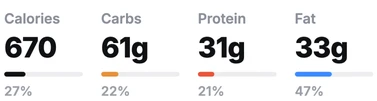
A meal logged in Joules, showing 670 calories with 61 g carbs, 31 g protein and 33 g fat

One photo, one tap — the plate comes back broken down.

Content last reviewed 29 August 2026. Estimates for healthy adults, not medical advice.